COMER — Committee on Monetary and Economic Reform EST. 1986 |
||||||||
|
||||||||
![]() |
Meltdown: Money, Debt and the Wealth of Nations, Volume 1 (1988–98)An important critique of 10 years of economic policy blundering that led to today's unsustainable global casino – with many key proposals for reform and a more sensible, equitable and financial architecture for our common future. $20 [+ shipping and handling] More |
![]() |
Meltdown: Money, Debt and the Wealth of Nations, Volume 2 (1999–01)To put
the economies of the world under the complete control of the financial
sector...brought on the Depression of the thirties that led to the
Second World War... The inescapable one way out from a Third World
War, which appears more inescapably in the offing, is to prevent
our governments from persisting in the dumbing-down process of our
society. |
![]() |
Meltdown: Money, Debt and the Wealth of Nations, Volume 3 (2002–03)The theme here is the headlong Wall Street encounter of the mathematics of the atomic bomb translated into big business format. Big Trouble. Our governments have not even come close to finding their way out of this major catastrophe. To do so would require that they dig up the teaching of some of our greatest economists, who they have so assiduously buried. It is the purpose of Meltdown and COMER to lend them a helping hand in this ever more urgent task. $20 [+ shipping and handling] More |
![]() |
Meltdown: Money, Debt and the Wealth of Nations, Volume 4 (Janary 2004–June 2005)“In the present volume we deal quite fully with the importance of human capital, once recognized but subsequently deliberately buried to allow our deregulated banks to continue their irresponsible escapade that threatens the survival of our civilization.… The major lesson of that is that education changes the very nature of the human race. The realities brushed upon by the Greek and Renaissance philosophers that redefined what man saw and measured and, hence, what man was and could be, has recreated him in command of the outer spaces. At the very time that more earthbound specimens are finding it tougher keeping even an automobile firm non-bankrupt and adequately fueled, others are learning to re-assess such problems in outer space with a lavish saving in time and fuel.” $20 [+ shipping and handling] More |
![]() |
Meltdown: Money, Debt and the Wealth of Nations, Volume 5 (July 2005–December 2006)“Our government is financed largely by borrowing in the market-place, and relying on taxation and shifting the burden of increasing amounts of services onto the provinces that pass a growing amount of the burden onto the provinces and municipalities, whereas that could be done directly or indirectly through the central bank at a nominal cost. This was actually done to finance Canada’s part in World War II, and then to catch up with many years of neglect during the Depression and World War II. It made possible for Canada not only to catch up with the neglect but to receive millions of mostly penniless refugees from Europe. We need only return to the most prosperous years of our history and make use of legislation that, unused, is still on our law books.” |
![]() |
Towards a Non-Autistic Economy — A Place at the Table for SocietyMarginal Utility theory “confuses scarcity with wealth,” according to Krehm. “It validates the speculative increase of demand on the stock market as the most prolific multiplier of ‘value’. That makes it obligatory to rethink economic theory from the bottom up.” $20 [+ shipping and handling] More |
![]() |
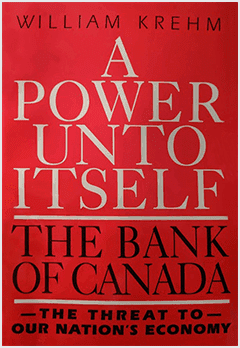
A Power Unto ItselfHere, Mr. Krehm highlights Canadian financial solutions that are easily within our grasp, showing:
|
![]() |
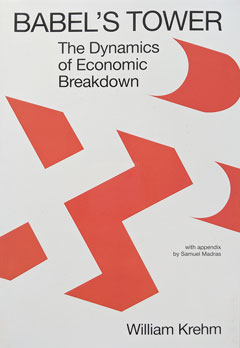
Babel’s TowerIn Tower Krehm develops a relativistic view of all economic theory. This is necessary, so as to establish the quite different logics that govern the subsystems that make up our pluralistic economy. Babel's Tower abounds with new concepts and tools that are indispensible for understanding and managing our mixed economy – structural quasi-rents, inter-sectorial transforms, modulus congruence calculus. The book is accessible to the intelligent layman. $10 [+ shipping and handling] More |
![]() |
Price in a Mixed Economy: Our Record of DisasterOur society has become a pluralistic one – with non-market forces feeding elements of price rise into the economy; our economic theory, however, has remained a monistic one that sees price determined by the self-equilibrating interplay of supply and demand. Price in a Mixed Economy formulates a grammar of economic feasibility that sets out the real choices open to society. $15 [+ shipping and handling] More |
![]() |
Democracies and Tyrannies of the Caribbean in the 1940’sDescribes vividly the tyrannical and corrupt forces that controlled, with U.S. support, most Central American countries at that time. No U.S. publisher would risk this book in the 40's. It was published in Spanish in 1949; the original English version in 1984; and again in 1999 with a new introduction by the author. Essential reading for those concerned with the recent history of Latin America. There is nothing quite like this book in its field. $15 [+ shipping and handling] More |
![]() |
How To Make Money In A Mismanaged Economy And Other EssaysFrom the preface: This is not meant to be a How to do it yourself book. It will be perfectly possible for readers to work their way through it, and not go on to make a million dollars. My original intent in developing the ideas contained in it was not to derive investment strategies – though they have served me well towards that end. My goal was rather to understand the novel patterns thrown up by our changing economy. $12 [+ shipping and handling] |
![]() |
It’s Your MoneyW.F. Hixson More |
The United Nations: Policy and
Financing Alternatives
|